‘Tis only God may be had for the asking.
—Lowell.
The Freewill Baptist denomination had its birth in New Durham, June 30, 1780. It was planted in fertile soil, and spread rapidly in the central part of the state. Probably the first decade of its existence had not passed before preachers of this denomination had penetrated this region and secured adherents to the new creed. In March, 1803, Rev. David Fisk removed from Boscawen to the east bank of the Pemigewasset river opposite the lower part of Bristol, and settled on what is still known as the Fisk farm. He commenced at once to hold preaching services at his house, and some were converted. These united with a few of the Freewill Baptist faith then residing in Bridgewater village and monthly meetings were held, half the time on the Bridgewater side of the river and half the time on the New Hampton side.
One of those living in Bridgewater village who united with this band was Dr. Timothy Kelly. He was a man of much strength of character, and occasionally preached or held meetings as an exhorter. He thought it a matter only of his own concern how much spirituous liquors he consumed, and when his brethren sought to labor with him on this account he rebelled and broke up the society. Then a band of twelve organized another society with Rev. David Fisk at the head, as before. In 1810,1 Mr. Fisk was ordained and given authority to administer the sacraments; viz., “baptizing, administering the Lord’s Supper, washing the saint’s feet, and anointing the sick with oil.” This society was called the “Second Freewill Baptist Church of New Hampton.”
In Bristol village there was occasional preaching by ministers of this denomination in the Methodist chapel and in other places. In 1829, there was an extensive revival of religion in the Second Freewill Baptist church in New Hampton under the labors of Elder Dudley Pettingill, the fruit of which extended to Bristol village. The next year, the Fisk meeting-house in New Hampton was built.
It will thus be seen that Freewill Baptist influences were at work in this community many years before there was a church or society of this denomination in Bristol village.
On the establishment of the church at Bristol some of the Freewill Baptist organizations, in the near-by outlying districts, lost their vitality and soon ceased to exist. The members of the Second Church in New Hampton voted, in 1854, to disband, a part taking letters to the First Freewill Baptist church at New Hampton village, and a part to the new church at Bristol ; the church in the Borough ceased to exist ; and a society at South Alexandria lost its identity, and some of its members became a part of the Bristol society.
The Bristol society was organized Sept. 20, 1845, under the name of The Bristol and Alexandria Freewill Baptist Society. The word Alexandria was inserted because some of the organizers were from South Alexandria, as noted above, and not because it was a union society of the two towns. Steps were at once taken looking to the erection of a meeting house; and Stephen Nelson, Favor Locke, William W. Pattee, and John M. R. Emmons were made a committee to select a location. It was decided to build a church forty-two feet wide and long enough to contain fifty-two pews. Thirty of the pews in the proposed church were subscribed for, but this was not enough to warrant building, and action was delayed till March, 1847, when the directors purchased of Walter Sleeper for $50 the old Methodist chapel. The chapel was at once repaired and the pews sold to cover the expense.
Preaching was sustained more or less of the time from the organization of the society; Rev. Ebenezer Fisk and Rev. David Calley being each engaged for one-third of the time. Elder Calley commenced his services in the spring of 1847, and was supplying this people at the time of the organization of the church, at which time he was chosen pastor. On the 21st of September, 1848, the Freewill Baptist church was organized in the old chapel. The council consisted of Elders Fisk, Calley, and Amos Brown. The charge was given by Elder Fisk. October 3, following. Favor Locke and William Eaton were elected deacons, and the following covenant was adopted:
COVENANT OF THE FREEWILL BAPTIST CHURCH IN BRISTOL, ADOPTED OCTOBER 3, 1848.
Preamble.
Having been brought, as we humbly trust, by divine grace to trust the Lord Jesus Christ as our Savior, through whose merits alone we hope to be saved; and believing that God requires us to unite our efforts to promote the interests of Christ’s Kingdom on the earth, in order more clearly to understand our duty to God, to one another, and to the world, we adopt the following as our
Church Covenant.
This church shall be known as the Free Will Baptist Church in Bristol. We agree to take the Holy Scriptures for our only rule of faith and practice, and to reject as human and dangerous whatever they do not require as of divine authority. We believe that the Treatise on the Faith of the Free Will Baptists contains a summary of the doctrines of the Bible, which we agree to own and defend according to the best of our ability. We solemnly covenant before God that we will strive by his assisting grace to exemplify our confession by a practice, which shall correspond to all which we have above professed. And we do now give ourselves publickly and renewedly to God to love and serve him till death–and to his people to live together with them in brotherly love and union. And we do solemnly covenant, that we will exercise a mutual Christian care and watchfulness over one another and will faithfully labor for the promotion of each others spiritual wellfare by fervent prayer, faithful admonitions and affectionate rebuke if necessary–will endeavor to restore the erring in the spirit of meekness, and labor together by prayer, precept and example for the salvation of sinners.
We do covenant that we will contribute of our substance for the support of a faithful ministry among us, and the necessary means of grace, and will be devoted to the needy and especially to the poor of our own church; and we will as far as we are able attend upon the public worship of God, and the stated meeting of the church, and will [pray] for its prosperity and uplifting in the most holy faith and we will not forsake it in adversity, but will bear each others burdens, and so fulfill the law of Christ. We will constantly maintain secret and family devotions, and we will religiously instruct those under our care, and will cordially cooperate with those who minister to us in holy things and will esteem them highly for their works sake.
We covenant that we will not traffic in nor use intoxicating drinks as a beverage, and that we will sustain the other benevolent enterprises of the day, as missions, Sabbath schools, moral reform, anti-slavery education, and all others which in the use of holy means, tend to the glory of God and the wellfare of men.
We covenant and agree that we will love all those who love our Lord Jesus Christ, and that we will avoid all extravagance and sinful conformity to the world, and will abstain from all sinful amusements, as theatre, dancing and gambling, and from all vain festivals, and will refrain from all unchaste and profane conversation, and from the reading of wicked and corrupting publications. We will walk circumspectly towards those without, that the cause of God be not reproached on our account.
And may the God of peace sanctify us wholly and preserve us blameless to the coming of our Lord Jesus Christ to join the glorified around the throne of God in ascribing blessing and honor and glory and power unto him that sitteth on the throne and unto the Lamb forever and ever. Amen.
Those who united with the church at its organization were William Eaton, Favor Locke and wife, John M. R. Emmons and wife, Mrs. Isaac Swett, Mrs. Sally Perkins, and Benjamin Q. Fellows.
Rev. David Calley closed his first pastorate of this church May 1, 1849, being obliged to relinquish public speaking on account of a throat trouble. Rev. Francis P. Newell succeeded him, and served till May 18, 1850.
In March, 1850, Elder Fisk proposed that the old chapel be torn down and a new edifice erected from the material, on land offered by him on Summer street. This was done a few months later and the present church was erected. The new edifice cost $1,260, and $900 was realized from the sale of pews. This work was done largely through the efforts and means of Elder Fisk, and he took the unsold pews in the new church as compensation. The pews in the old church were appraised at $1 each, and Gilman Ingalls, Jr., Stephen Nelson, and Joseph Kidder were the building committee.
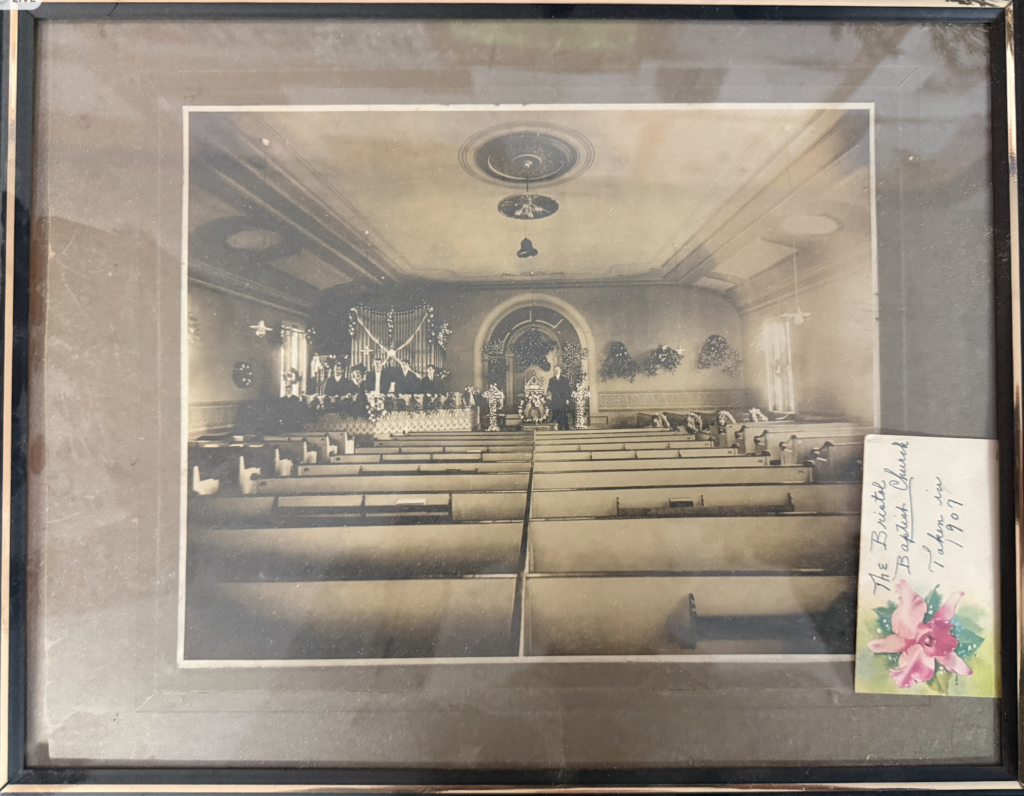
The new church was 40 x 48 feet square, and contained fifty-four pews. These were on a level except the singing seats in the south end which were raised two and three steps. The pulpit was between the two doors in the north end. Four years later, the basement was completed for a vestry.

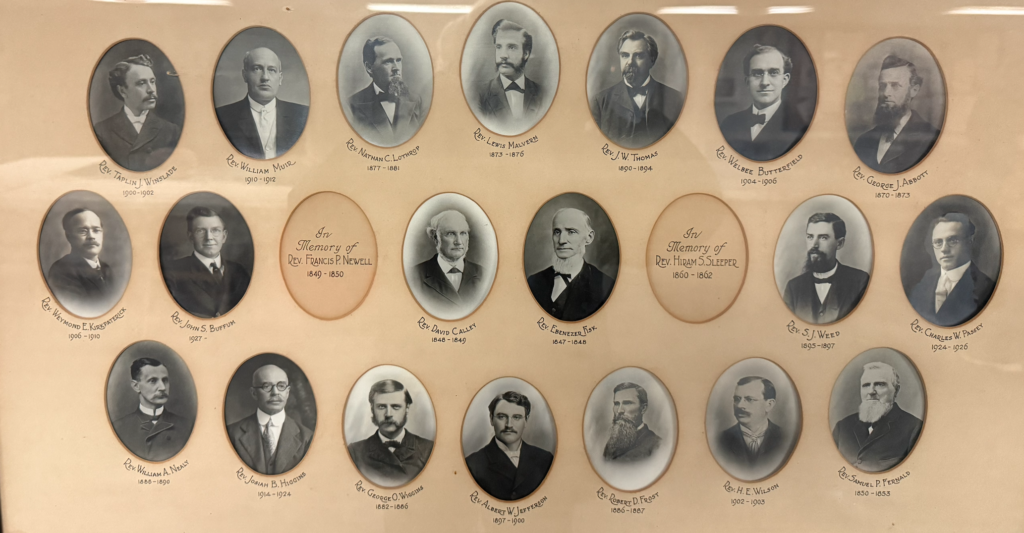
The first pastor in the new church was Rev. Samuel P. Fernald, who commenced his services here the same day that his predecessor retired. He continued here till September, 1853, when he closed a most acceptable pastorate. Mr. Fernald was born in North Berwick, Me., May 25, 1809. He was ordained at East Wolfeboro, May 26, 1833. He held pastorates at East Tilton, Northwood, Candia, Gilmanton Iron Works, where he remained nine years, Bristol, three years, Northwood, Portsmouth, Goshen, Me., Moultonboro, Tuftonboro, closing his pastorate at the last named place in 1870. He subsequently served one year at Holderness, two years at Water Village, and at Holderness again one year. He died in North Berwick, Me., June 9, 1888.
On the retirement of Mr. Fernald, Rev. David Calley again assumed the pastorate of this church and continued till 1860, serving seven years. During this time, he saw the society placed on a firm basis and general prosperity attend it.
Rev. Hiram S. Sleeper labored here from May 20, 1850, till March, 1862. Mr. Sleeper was born in New Sharon, Me., Jan. 11, 1811. He was licensed to preach by the Farmington quarterly meeting in 1839. and was ordained in December, 1842. He served as pastor of the Freewill Baptist church at Gardner, Me., for two years; at Monhegan, Me.; at Phippsburg, Me.,four years. After preaching fifteen years, he entered the New Hampton Biblical Institute, but left before the end of the year to accept a call to the pastorate of the church at Upper Gilmanton, where he remained five years from November, 1855. After his Bristol pastorate, he served four years at Loudon, and was pastor of the Freewill Baptist church at Meredith Center when he died, Aug. 11, 1867.
Rev. David Calley, for the third time, became pastor of this church on the retirement of Mr. Sleeper, and continued another seven years. During this last pastorate, the church edifice was remodeled (1867). Ten feet was added to its length on the south, entries were made in the front end, the orchestra and the pulpit were transposed, the pews turned round and a furnace placed in the basement. These changes cost $800, of which $500 was raised by an assessment on the pews.
Rev. David Calley professed religion at the age of twenty-three, and the next year (1837) he received a license to preach. In May, 1842, he was ordained at the Sandwich Quarterly meeting, and the next month he became the pastor of the Freewill Baptist church at No. Tunbridge, Vt., where he remained till April, 1847. He then resigned and went to Plymouth to care for his father in his last sickness. During his residence at Plymouth, he preached at Holderness and other places, and commenced his labors as a supply for the church at Bristol. After retiring from his first pastorate at Bristol, he preached but once for three years; but, in 1852, he resumed public work and continued in the active work of the pastorate for forty years. After his second pastorate at Bristol, he returned to North Tunbridge, Vt., where he remained three years and then again returned to the Bristol church for another seven years. Mr. Calley thus served sixteen years as pastor of the Bristol church. To no one man does this church owe more than to Rev. David Calley. He was a man of great natural abilities, an excellent preacher, devoted, godly and his pure life and disinterested labors endeared him to all classes in the community. He was of fine personal presence, standing six feet, two inches high. After retiring from the work in Bristol, he labored two years in Alexandria; eight years in Sandwich; two years again in Alexandria, and five years in North Sandwich till 1887, Center Sandwich, South Tamworth, and Meredith Center, where he closed his pastoral labors in May, 1892. Mr. Calley is still living in Bristol at the good age of eighty-seven, beloved and respected by all. He still does occasional service.
Rev. George J. Abbott commenced to serve this people as pastor June 1, 1870, and continued till September, 1873. In 1872, the audience room was finely frescoed. Mr. Abbott was born in Jackson, Me., in 1830. He was educated at New Hampton and ordained, June, 1858, at Unity. His pastorates were South Monteville, Wayne, and Dover, Me.; Gonic, Bristol, Hampton; Apponaug, R. I., and at Oakland, Me., where he died Nov. 3, 1883, aged fifty-three years.
Rev. Lewis Malvern served this church as pastor from September, 1873, till March, 1876. Mr. Malvern was born in Cheltenham, England, June 9, 1846. He was educated at New Hampton, licensed to preach in 1867, and ordained by the Sandwich Quarterly meeting June 3, 1874. His first pastorate was Bristol, and his work here greatly strengthened this church and increased its membership. During his pastorate, a pipe organ was placed in the church at a cost of $800. He left Bristol, and went to Laconia, thence to Manchester, and again to Laconia, where he filled a long pastorate. He is now pastor of a church in Portland, Me.
Rev. Lewis Malvern was succeeded by Rev. William C. Hulse, who served as pastor from August, 1876, till February, 1877. Rev. Nathan C. Lothrop assumed the pastorate of this church in May, 1877, coming from Candia, and continued till April, 1881. In January, 1879, the afternoon service at this church was discontinued. Mr. Lothrop fitted for the ministry at New Hampton, graduating from the literary department in 1861. Before coming to Bristol, he was pastor at South Berwick, Me., at Milton. Strafford, and Candia. Since leaving Bristol, he has filled pastorates at Deerfield, where he remained four and one-half years and added forty-two to the church; at Lebanon. Me., Contoocook, and Strafford Corner, and now at Contoocook.
Aug. 15, 1880, a farewell service was tendered Rev. Ebenezer Fisk at this church, it being the last Sunday previous to his departure for the West to make his home with his son. The communion was administered. Remarks were made by Rev. H. S. Thompson, of the Methodist church; by Rev. Newell Culver; Rev. E. E. Jaggar. of the Congregational church; by Mr. Fisk, and others. The service was very fitting and touching. When the Second Freewill Baptist church at New Hampton disbanded, Mr. Fisk took a letter to the church at New Hampton village, and yet he may appropriately be called the father of the church in Bristol. It was through his liberality that the church edifice was built, and in every emergency he was a liberal contributor. Mr. Fisk was a remarkable man. He was born in Boscawen, Oct. 1, 1802. He studied at the old institution at New Hampton, and when twenty years of age consecrated himself to God. He was licensed to preach in 1828 ; ordained by the Sandwich Quarterly conference Nov. 4. 1830, and at once became associate pastor, with his father, of the Second Freewill Baptist church in New Hampton. His father died Feb. 9, 1834, and he continued in charge of this church for twenty years. He was a farmer as well as a preacher, a man of spotless character, possessed an unusual amount of common sense and great native eloquence, gifted in prayer, of large sympathy with his fellowmen and great faith in God. He died at Jackson, Mich., Oct. 2, 1890, aged eighty-eight years and one day.
Rev. Geo. O. Wiggin became pastor of this church in April, 1882. He was ordained as a Christian minister and installed as pastor of this church at a session of the Sandwich Quarterly meeting in Bristol, Aug. 24, 1882. These services were largely attended and much interest was manifested. The program was as follows: Invocation and reading Scriptures, Rev. C. W. Griffin, Alexandria; prayer, Rev. J. W. Scribner, New Hampton; sermon. Rev. E. W. Porter, Lowell, Mass.; ordaining prayer, Rev. David Galley, Sandwich ; charge to pastor. Rev. Mr. Scribner ; right hand of fellowship, Rev. E. H. Prescott, New Hampton; charge to church, Rev. J. B. Davis, Meredith. Mr. Wiggin retired in April, 1886. In July, following the retirement of Mr. Wiggin, Rev. Robert D. Frost became pastor and remained nine months, retiring in April, 1887. Mr. Frost was born in Sugar Grove, Ill., Oct. 15, 1846. He was graduated from Hillsdale college, March, 1873; from Bates, 1881, and ordained at Dover in February, 1874. March 18, 1874, he sailed for India as a missionary and returned in March, 1876. His pastorates before coming to Bristol were Limerick, Me., and Grafton, Mass. From Bristol he went to Block Island, R. I.
Rev. William A. Nealy assumed the pastoral care of this church in June, 1888, and he continued the work till declining health compelled him, in January, 1890, to tender his resignation, to take effect Feb. i . He died June 28, following. Mr. Nealy was a most devoted and faithful man and he spared not himself to minister to his people. Mr. Nealy studied at Green Mountain seminary, and was ordained to the Christian ministry Dec. 22, 1872. Before coming to Bristol he was pastor of the Freewill Baptist church at Franklin, Vt.; Putnam, N. Y.; East Orange and Topsham, Vt.; Tiverton and Arlington, R. I.
Rev. J. W. Thomas succeeded Mr. Nealy, Mr. Thomas was ordained by the Rhode Island and Eastern Connecticut conference in 1866, before he had reached the age of twenty years. He labored with marked success among the churches of southern Massachusetts till 1877, when he went to the Pacific coast on account of his health, and became connected with the Golden Gate association of the Free Baptists. In 1890, he came east, and in August of that year assumed the pastoral care of this church and continued till May, 1894. Mr. Thomas was an efficient and faithful worker, and did good service for this church. He was ably assisted by Mrs. Thomas, who was an excellent gospel singer. She also took charge of the social meetings and filled the desk on the sabbath when her husband could not be present. Since leaving Bristol, Mr. Thomas has filled pastorates at Brunswick, Me., and Rockland, Me. He is now living in Roxbury, Mass.
The church edifice was further improved in the spring of 1894, when the pews were reset, the orchestra placed at the right of the desk, carpets laid, colored glass windows put in, walls refrescoed, and the steeple rebuilt. The church was rededicated Thursday, June 28. The dedicatory sermon was preached by Rev. Geo. L. White, of New Hampton. Revs. G. O. Wiggin, David Calley and N. C. Lothrop, all former pastors, assisted in the service, and the benediction was pronounced by Rev. A. B. Meservey, Ph. D.
Rev. Simeon J. Weed commenced his services as pastor of this church May 1, 1895, and continued till March 31, 1897. Mr. Weed was born in Gallia County, Ohio, March 11, 1854. He was ordained in September, 1877, and was settled over the Harrisburg, Ohio, church. His other pastorates before coming to Bristol were Jennersville and Dunnings Creek, Pa.; Cottonwood, Ill., and Colebrook and Green, Ohio.
Rev. Albert W. Jefferson was pastor of this church from June 1, 1897, till Mar. 1, 1900. This was Mr. Jefferson’s first pastorate. He was a fine scholar and an eloquent speaker, and the church made substantial gains during his pastorate. His retirement was a great loss to the church and the community. On Saturday evening, before his departure, a reception tendered him was largely attended and he was presented with a quilt containing the names of 500 people. On leaving Bristol, Mr. Jefferson assumed the pastorate of the Free Baptist church at Pawtucket, R. I.
Rev. Taplin J. Winslade succeeded Mr. Jefferson. Mr. Winslade was born in London, Eng., in 1870, and came to the United States when twenty years of age. He took a course of study at the Gordon Missionary Training school in Boston and then labored for some years as an evangelist. He first preached as a supply for this church Mar. 8, 1900, and Mar. 27, following, a call was extended to him to become its pastor, which he accepted. Jan. 30, 1901, he was ordained in the Free Baptist church. The opening prayer was offered by Rev. Daniel Onstott, pastor of the Methodist church;
the sermon was by Rev. J. Franklin Babb, of Ashland; presentation of candidate, by Rev. F. L,. Wiley, of I,aconia; prayer of consecration, by Rev. J. Erskine, of Meredith, who was joined in the laying on of hands, by Mr. Wiley and Rev. O. D. Patch, of Manchester; charge and conferment were given by Mr. Patch ; the right hand of fellowship was extended by Mr. Davis; address to the church. Rev. E. G. Eastman, of Meredith; welcome to the field, Rev. John W. Savage, pastor of the Congregational church ; benediction by Rev. Mr. Winslade. Mr. Winslade was an indomitable worker, and under his labors the attendance at church and the social meetings largely increased and that of the Sunday-school doubled. He closed his pastorate here June 30, 1902, and accepted the pastorate of the church at Orr’s Island, Me., and at the same time, began a course of theological study at Cobb Divinity school, Lewiston, Me. In October, following, he assumed the pastorate of the Free Baptist church at Lisbon Falls, Me., continuing his studies at Lewiston. Mr. Winslade was succeeded by Rev. H. E. Wilson, who is now serving this church.
MEMBERSHIP
In 1850, the membership of this church was reported as 34; in 1860, as 69; 1870, 70; 1880, 126; 1890, 107; 1895, 101; 1900, 100; 1902, 105.
PASTORS
David Calley, Oct. 3, 1848-May 1, 1849.
Francis P. Newell, May 1, 1849-May 18, 1850.
S. P. Fernald, May 18, 1850-September, 1853.
David Calley, September, 1853-May 20, 1860.
H. S. Sleeper, May 20, 1860-March, 1862.
David Calley, March, 1862-March, 1870.
George J. Abbott, June 1, 1870-September, 1873.
Lewis Malvern, September, 1873-March, 1876.
William C. Hulse, August, 1876-February, 1877.
Nathan C. Lothrop, May, 1877-April, 1881.
A. B. Sherwood, supplied four months.
E. C. Clark, supplied four months.
George O. Wiggin, April, 1882-April, 1886.
R. D. Frost, July, 1886-April, 1887.
W. A. Nealy, June, 1888-Feb. 1, 1890.
J. W. Thomas, August, 1890-May 1, 1894.
S. C. Eldridge, supplied a few months.
George W. Sanborn, supplied 24 Sundays.
S. J. Weed, May 1, 1895-Mar. 31, 1897.
Albert W. Jefferson, June 1, 1897-Mar. 1, 1900.
Taplin J. Winslade, March, 1900-July 30, 1902.
H. E. Wilson, Aug. 1, 1902.
DEACONS
Favor Locke, October, 1848-June, 1870.
William Eaton, October, 1848-Sept. 1, 1852.
Joseph Rollins, Sept. 1, 1852-June 1, 1870.
Moses W. Favor, June 1, 1870, resigned.
Nicholas T. Chase, June 1, 1870-Nov. 27, 1893.
Everett J. Gordon, Aug. 1, 1901.
Noah L. Sinclair, Aug. 1, 1901.
1In 1804, this new denomination had so increased that it received legal recognition in the state by the passage in the legislature of a resolution “that the people of this state commonly known by the name of Freewill Anti-paedo Baptist church and Society shall be considered as a distinct religious sect or denomination, with all the privileges as such agreeably to the constitution.”